
Based on 700-year cultural tradition
Chart workflow reflects widely circulated historical table usage across Chinese-speaking communities.
Baby boy or girl calculator: enter two dates for an instant cultural chart result.
Use our free Chinese gender predictor to estimate boy-or-girl outcomes from maternal birth date and estimated conception date. The experience is designed for fast tool use, but also includes in-depth educational content covering history, science, and responsible pregnancy guidance so users can distinguish cultural tradition from clinical evidence.
Chart workflow reflects widely circulated historical table usage across Chinese-speaking communities.
Community participation powers transparent trend reporting and educational analysis.
No sign-up required for prediction, with clear separation between entertainment and medical guidance.
Important Medical Statement
This tool is for culture and entertainment. Reliable fetal sex determination requires validated medical methods such as NIPT or ultrasound under licensed prenatal care.
Start with the calculator below, then continue to our complete 2026 guide and lunar conversion explainer if you want deeper context.
Live chart lookup
Enter two dates
We publish aggregate trends to keep claims transparent. The dashboard is educational and does not imply clinical validity.
Predictions completed
127,543+
Community reported accuracy
51.2%
Average session duration
3m 42s
Countries reached
62
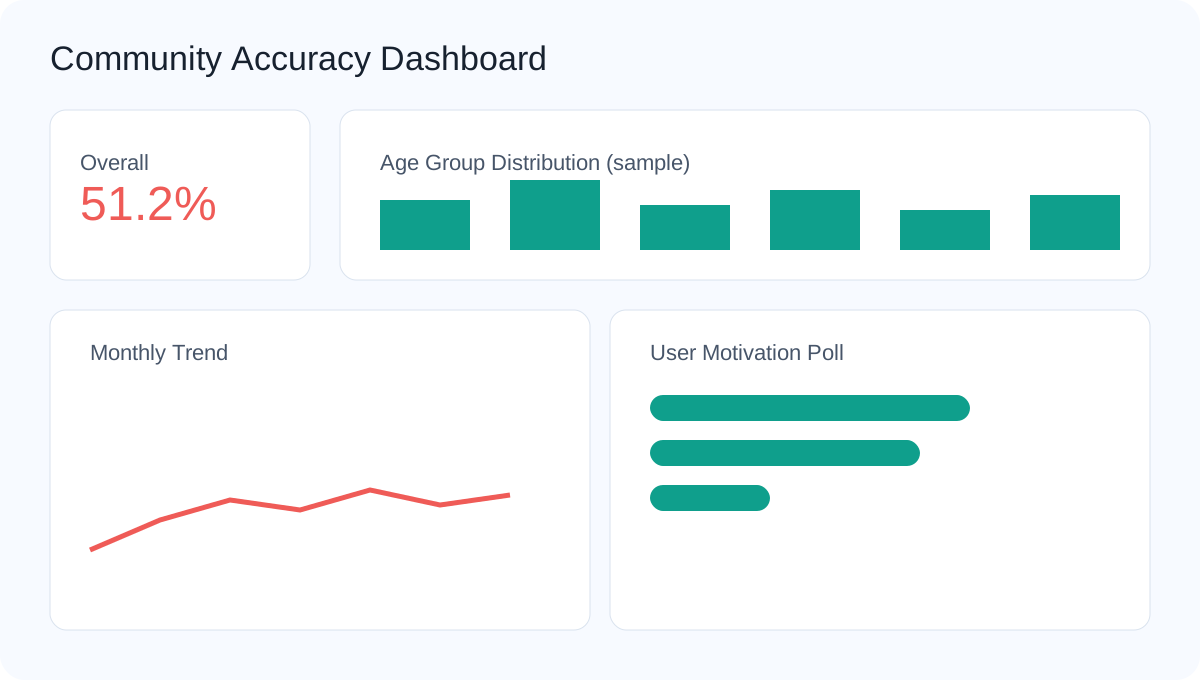
Short answer: in our community sample, chart alignment is about 51.2%, which is near random chance. Traditional charts are culturally meaningful but not clinically validated.
The chart is often shared as a family ritual across generations. Many users report emotional value, bonding moments, and a sense of connection to ancestral practices. If you want historical context, see the 700-year origin story and cross-region cultural significance.
Biological sex is linked to chromosomal inheritance, not lunar age. Clinical methods such as NIPT and ultrasound are evidence-based. Read myths vs facts and medical determination guidance for details.
We separate culture content from health claims, keep disclaimers visible, and cite authoritative references. Our goal is to reduce misinformation while preserving cultural storytelling. Methods and caveats are documented in the accuracy research guide.

Pregnancy safety framing and evidence review
Health-adjacent content is reviewed against established prenatal care guidance before publication or major updates.
Medical Review Note
All health-adjacent claims on this page are written with evidence-based language and checked for safety framing. Traditional chart output is explicitly labeled as entertainment.
Our review standard is simple: treat traditional gender charts as cultural entertainment, and direct anyone who needs certainty toward validated medical pathways such as ultrasound or NIPT under licensed prenatal care.
Chinese Gender Predictor review process
The Chinese gender chart is frequently described as a Qing-era artifact found in royal archives, then copied and reinterpreted through newspapers, almanacs, and modern websites. Historical accounts differ, and some versions blend folklore with later editorial updates. Instead of claiming certainty, we document what is known, what remains disputed, and why users still engage with the method today.
In practical use, the chart maps two variables: maternal lunar age and lunar conception month. That matrix design explains why different conversion assumptions can produce different outcomes from the same dates. A one-day shift around lunar month boundaries can move a user into a neighboring cell, creating a different prediction. This is one reason we expose conversion choices rather than hiding them.
Cultural significance is broad. Families in mainland China, Taiwan, Hong Kong, Singapore, and diaspora communities often use the chart during early pregnancy conversations. Many users do not treat it as a scientific instrument; they use it as ritual play, family storytelling, or a conversation starter before clinical appointments. That distinction matters because it sets healthy expectations and protects trust.
Modern adaptations introduced additional complexity. Some charts remove leap-month logic, some map lunar age using virtual age, and some merge local variants into a single table. These edits may increase convenience but also reduce consistency. Our editorial approach is to maintain transparent assumptions, annotate edge cases, and link users to deeper references that explain why chart versions diverge.
Popular storytelling often frames the chart as a royal secret discovered in an imperial tomb or archive. That narrative is memorable, but archival certainty is weaker than internet summaries suggest. Some references are secondary retellings without direct citation to primary records. A people-first approach is not to dismiss tradition, but to mark confidence levels: which claims are supported by historical records, which are plausible but uncertain, and which are modern embellishments for marketing.
Cultural products can still be valuable even when origin stories are partially symbolic. Families do not always seek historical precision; they seek ritual, anticipation, and shared meaning. The key publishing responsibility is disclosure. We preserve the narrative but avoid presenting folklore as verified medical or historical fact. That trust-oriented framing supports both user dignity and long-term content quality.
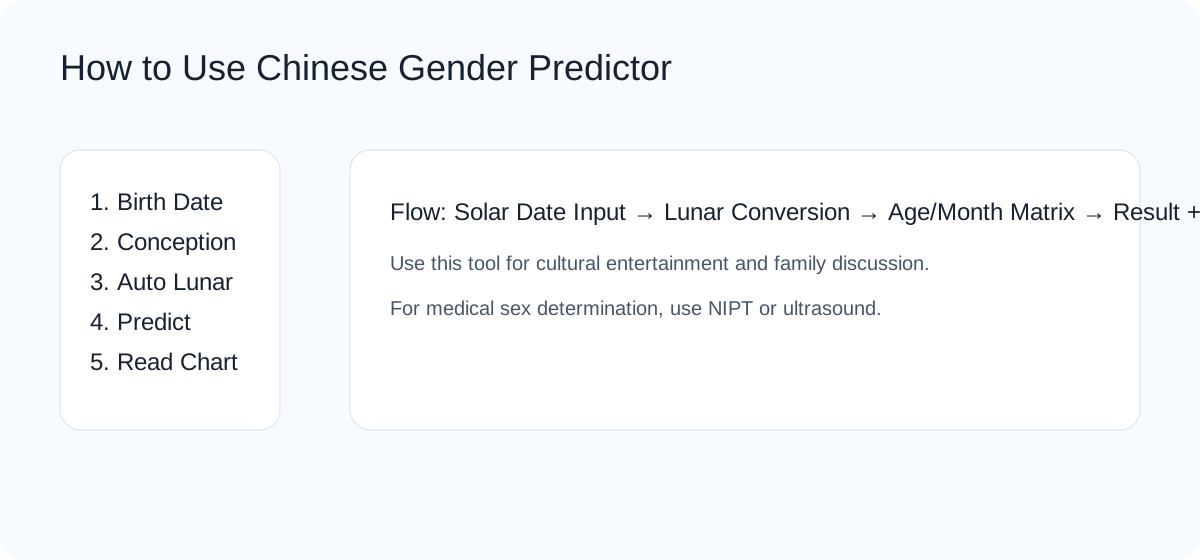
Step one is collecting a reliable maternal birth date and conception estimate in solar format. Step two is conversion: both dates are mapped to lunar calendar values with consistent rules around boundaries and leap months. Step three calculates lunar age using a documented convention. Step four maps age and month into the chart matrix. Step five communicates result with explicit caveat language, including the entertainment-only designation and pointer to clinical methods when certainty is required.
Most user confusion appears in steps two and three. If two websites disagree, differences usually come from conversion assumptions rather than user error. A transparent tool should surface these assumptions directly in UI or documentation. Hidden conversion logic can inflate perceived certainty while reducing reproducibility, which undermines user trust and search quality over time.
In mainland communities, chart use is often informal and family-led, especially during first trimester conversations before medical confirmation windows. In Hong Kong and Taiwan, chart references may appear in lifestyle media and family forums with local language variation. In Southeast Asian Chinese diaspora communities, chart rituals can function as identity continuity, linking modern digital pregnancy journeys with inherited household practices.
Across these contexts, one consistent pattern emerges: users can appreciate symbolic methods while still relying on clinical prenatal care for decisions. That coexistence should guide product design. The tool experience can stay engaging and culturally resonant, while educational layers clearly separate ritual interpretation from evidence-backed health guidance.
There is no single universal table used by every publisher. Some versions modify rows, others alter age range, and many omit leap-month handling. Some platforms also infer conception date from due date with simplified arithmetic that can shift month boundaries. These implementation choices create output drift, which users interpret as chart disagreement when it is often conversion disagreement.
For this reason, we publish a stable matrix and method notes rather than hiding internals behind a single button. In long-term SEO, transparent method communication is itself a quality signal: it demonstrates expertise, reduces ambiguity, and encourages informed use rather than blind trust in unexplained results.
If your goal is to learn the method itself, start with the step-by-step usage guide. If your goal is to understand history and reliability, continue with historical origin analysis and probability interpretation for 50/50 outcomes.
Biological sex determination is linked to chromosomal combinations at fertilization, not calendar arithmetic. Traditional charts can appear persuasive because humans naturally search for patterns after outcomes are known, but pattern recognition is not the same as causal evidence. This is why responsible pregnancy content should always separate folklore from medical claims.
Ultrasound, NIPT, and invasive diagnostic procedures each play different roles in prenatal care. Ultrasound is routine and widely available in many regions, while NIPT offers high screening sensitivity from early pregnancy windows. Invasive tests such as amniocentesis and CVS can provide diagnostic clarity when medically indicated but involve procedure-specific risk discussions with clinicians.
A common misunderstanding is that a 50-51% chart alignment proves partial validity. It does not. For a binary outcome like boy-or-girl, random guessing can already produce around 50% over large samples. Strong evidence would require reproducible, statistically significant uplift beyond chance in controlled conditions. Current public evidence does not support that uplift for calendar charts.
If your decision requires medical certainty, cultural tools should not drive next actions. Use this page for context, then move to licensed care pathways. We provide this section so users can enjoy tradition without confusing entertainment with healthcare.
Ultrasound is widely used for fetal development assessment and can also provide sex estimation at appropriate gestational windows. Accuracy depends on imaging conditions, fetal position, and operator factors. It is important to interpret ultrasound findings in full prenatal context rather than reducing appointments to a single boy-or-girl question. In a quality content ecosystem, users should understand that ultrasound supports broader maternal-fetal monitoring, not only gender curiosity.
Timing also matters. Early scans may not provide clear views, and later views can still be limited by position or technical constraints. Responsible guidance therefore avoids absolute language and encourages users to rely on provider interpretation. Presenting confidence intervals and practical uncertainty is a stronger trust signal than simplistic certainty claims.
NIPT is a screening approach based on cell-free fetal DNA in maternal blood and is commonly offered from around week ten in many systems. It can provide highly reliable fetal sex estimates in many situations, but screening is not always equivalent to definitive diagnosis for all genetic contexts. Where uncertainty remains or high-risk markers appear, providers may discuss confirmatory diagnostic procedures.
Amniocentesis and chorionic villus sampling are diagnostic options used when medically indicated. These procedures involve risk-benefit evaluation that cannot be replicated by internet tools. A people-first page should therefore direct users to clinician-led counseling whenever a result may influence healthcare decisions, anxiety levels, or pregnancy management choices.
Human memory overweights correct predictions and under-remembers misses. This confirmation bias explains why family anecdotes can feel statistically stronger than they are. Social reinforcement amplifies the effect: when a story fits expectations, it is shared more widely; when it fails, it is often forgotten. Over time, selective storytelling creates an illusion of predictive power without controlled evidence.
Another driver is base-rate neglect. For binary outcomes, any method can appear surprisingly accurate around half the time by chance alone. Without baseline comparison, users may interpret 51% as proof rather than noise. Our content intentionally repeats this statistical framing because repetition supports better decision quality and reduces harm from overconfidence.
If your goal is family fun, a traditional chart can be a meaningful ritual. If your goal is clinical certainty, use validated prenatal pathways. If your goal is emotional preparation, combine playful tools with trustworthy educational reading and clinician consultation. Goal-method alignment prevents expectation gaps and supports safer pregnancy decision behavior.
We encourage users to discuss any concerns with their care team, especially when results may affect stress, planning, or family pressure. In product terms, this is where E-E-A-T moves from abstract concept to real user protection: accurate framing, source transparency, and practical next steps.
Often used in routine prenatal anatomy scans and commonly reported as high-accuracy in appropriate conditions. Result quality can vary by gestational age, fetal position, and imaging factors.
Blood-based screening that can estimate fetal sex with high reliability in many contexts while also screening selected chromosomal conditions. Confirmatory pathways depend on provider guidance.
Diagnostic procedures generally reserved for specific clinical indications. Discuss timing, benefits, and risk profile with obstetric specialists before proceeding.
Continue reading: how chromosomes determine sex, why traditional predictions feel convincing, and a full medical decision guide by trimester.
Users arrive with different goals, and content quality improves when guidance matches intent instead of forcing one narrative for everyone. If a user wants a fun family moment, a traditional chart can provide shared anticipation with low friction. If a user needs confidence for healthcare decisions, a chart is the wrong tool and should never be treated as a decision instrument. This intent-first framing reduces confusion, lowers misinformation risk, and builds trust with both users and search engines.
In early pregnancy, uncertainty can create emotional pressure and conflicting advice from social circles. A people-first page should acknowledge that experience instead of dismissing it. Users can value ritual and still seek evidence. We explicitly recommend that traditional predictions remain in the entertainment lane, while medical decisions stay with licensed prenatal care teams. This dual framing respects culture without diluting scientific standards.
For users around week 10 and beyond, discussions about screening options may include NIPT depending on local practice and provider guidance. Later prenatal windows often include ultrasound pathways that can support sex estimation under suitable imaging conditions. For high-risk or complex contexts, diagnostic procedures may be discussed by specialists. The right pathway depends on clinical indication, not chart output, and this distinction should remain clear on every high-traffic pregnancy page.
Family dynamics are another practical factor. In some households, relatives may place strong emotional weight on prediction rituals. Product copy should gently redirect pressure by emphasizing uncertainty and clinical alternatives. We intentionally use language that avoids certainty words in entertainment sections and reserves stronger confidence language for validated medical pathways. This wording strategy protects users who might otherwise feel compelled to act on symbolic predictions.
Geography and access also matter. Not every user has immediate access to the same tests, and timelines vary across healthcare systems. A strong information architecture therefore includes references to trusted institutions, clear caveats about local variation, and practical prompts to consult local providers. We avoid over-specific universal prescriptions where regional policy differences can change options.
For product teams, this framework also supports measurable UX improvements. Users with playful intent should complete predictions quickly and enjoy sharing tools. Users with informational intent should find direct routes to science explainers, medical method comparisons, and references. Users with high-anxiety intent should encounter clear reassurance through transparent disclaimers and actionable next steps. By mapping design to intent clusters, we increase relevance while preserving safety and credibility.
Suggested reading sequence: start at chart usage instructions, continue to probability interpretation, then review clinical determination pathways. This sequence mirrors the user journey from curiosity to informed action.
We report aggregate outcomes to avoid cherry-picking success stories. Across the current dataset, overall chart alignment is 51.2%. Age segments and month segments fluctuate around that baseline, which is what we would expect when variation is mostly random. Publishing this openly is part of our trust strategy.
User motivation data explains continued popularity despite near-random accuracy. Around 45% say they use the tool for entertainment, 38% for cultural connection, and 17% from curiosity. These responses show the product is valuable as a cultural experience when presented responsibly, not as a substitute for medicine.
We also compare chart outcomes with other folklore methods such as heartbeat myths or symptom-based guesses. All methods cluster around chance-level behavior in user-reported datasets. This cross-method perspective helps users avoid overconfidence from isolated anecdotes.
Methodology details, inclusion criteria, and chart version controls are documented in the full 10,000+ prediction analysis and user feedback insights 2026.
Observed alignment by age bands typically oscillates around chance with no stable directional advantage. Some short windows look higher or lower, but confidence shrinks once we control for sample imbalance, recall bias, and reporting delay. This is exactly why publishing single-month spikes without context can mislead users. We prioritize multi-period aggregation and transparent caveats.
Monthly variance can reflect calendar conversion boundary behavior rather than genuine predictive signal. When conception estimates sit near month transitions, small date shifts can move users into adjacent lunar months. We flag these sensitivity zones in our long-form research pages so readers understand why one result may differ from another site even with similar inputs.
Publishing near-random outcomes may look counterintuitive for a prediction product, but it strengthens long-term credibility. Users increasingly reward honest framing over inflated claims, and search systems also favor content that is clear about uncertainty. In practice, transparency supports retention because readers understand they are receiving context, not hype.
| Method | Observed Alignment | Evidence Level | Use Case |
|---|---|---|---|
| Chinese gender chart | 51.2% | Cultural folklore | Entertainment |
| Fetal heartbeat myth | 50.1% | Unsupported | Entertainment |
| Symptom severity guess | 49.8% | Unsupported | Entertainment |
| Abdominal shape myth | 50.3% | Unsupported | Entertainment |
| Clinical methods (NIPT/US) | High clinical reliability | Validated | Medical care |
Lunar calendars track month cycles by moon phases, while the solar Gregorian calendar tracks Earth orbit. Because these systems drift and realign differently, date conversion is not a simple one-to-one mapping. Accurate conversion is essential when tools depend on lunar month boundaries.
Lunar age calculations can also vary by convention. Some systems treat newborns as age one, some adjust age around lunar new year, and some use region-specific simplifications. If a website hides its conversion method, users may see inconsistent results and incorrectly assume the chart itself changed.
Our current implementation converts both input dates to lunar values and applies a documented virtual-age pattern used by many modern chart versions. When age falls outside the classic matrix range, we clamp to nearest supported row and surface a note. This avoids silent failures and improves interpretability.
Edge cases include leap months, cross-year conceptions, IVF timing references, and uncertain conception estimates. For each case, we recommend users compare chart output with prenatal care guidance rather than over-interpreting a single entertainment result.
Example one: a user enters a conception date near lunar new month. Depending on whether local timezone or standardized conversion is used, the mapped lunar month can shift. Example two: a leap month year can introduce ambiguity if a tool does not specify leap-month treatment. Example three: IVF transfer timing may not align with simplified natural-conception assumptions, requiring careful interpretation.
These examples show that conversion quality influences output more than many users realize. We therefore place method notes alongside results and recommend cross-checking if dates are near boundaries.
More details are available in the lunar conversion guide and our complete lunar pregnancy guide.
Gender prediction folklore appears in many cultures. Japanese and Korean traditions include date-based and seasonal interpretations, while South Asian communities may include astrological models. In Western contexts, old family heuristics about belly shape or cravings remain common despite limited evidence.
These traditions persist because they create narrative and ritual, especially during early pregnancy when uncertainty is high. They are social tools that can strengthen family participation, provided they are not confused with medical diagnosis.
Our editorial standard is to present global methods with equal transparency: cultural value can coexist with scientific limits. This approach supports respectful storytelling while protecting readers from misleading certainty claims.
Explore historical context in our cultural history overview.
When folklore methods are compared under similar evaluation rules, most sit near chance-level outcomes. That does not erase their cultural role, it clarifies their scope. We recommend treating all non-clinical methods with equal caution and equal respect: they can support storytelling, but should not guide medical decisions.
Heatmap format for faster reading. Coral indicates boy and jade indicates girl. For walkthrough examples, read the detailed chart usage tutorial and the full lunar pregnancy guide.
| Lunar Age | M1 | M2 | M3 | M4 | M5 | M6 | M7 | M8 | M9 | M10 | M11 | M12 |
|---|---|---|---|---|---|---|---|---|---|---|---|---|
| 18 | Girl | Boy | Girl | Boy | Boy | Boy | Boy | Boy | Boy | Boy | Boy | Boy |
| 19 | Boy | Girl | Boy | Girl | Girl | Boy | Boy | Boy | Boy | Girl | Boy | Girl |
| 20 | Girl | Boy | Girl | Boy | Boy | Boy | Boy | Boy | Boy | Girl | Boy | Boy |
| 21 | Boy | Girl | Girl | Girl | Girl | Girl | Girl | Girl | Girl | Girl | Girl | Girl |
| 22 | Girl | Boy | Boy | Girl | Boy | Girl | Girl | Boy | Girl | Girl | Girl | Girl |
| 23 | Boy | Boy | Girl | Boy | Boy | Girl | Boy | Girl | Boy | Boy | Boy | Girl |
| 24 | Boy | Girl | Boy | Boy | Girl | Boy | Boy | Girl | Girl | Girl | Girl | Girl |
| 25 | Girl | Boy | Boy | Girl | Girl | Boy | Girl | Boy | Boy | Boy | Boy | Boy |
| 26 | Boy | Girl | Boy | Girl | Girl | Boy | Girl | Boy | Girl | Girl | Girl | Girl |
| 27 | Girl | Boy | Girl | Boy | Girl | Girl | Boy | Girl | Boy | Boy | Girl | Boy |
| 28 | Boy | Girl | Boy | Girl | Girl | Girl | Boy | Girl | Boy | Boy | Girl | Girl |
| 29 | Girl | Boy | Girl | Girl | Boy | Boy | Girl | Boy | Boy | Boy | Boy | Boy |
| 30 | Boy | Girl | Girl | Girl | Girl | Girl | Girl | Girl | Girl | Boy | Boy | Boy |
| 31 | Boy | Girl | Boy | Girl | Girl | Girl | Girl | Girl | Girl | Boy | Boy | Boy |
| 32 | Boy | Girl | Boy | Girl | Girl | Girl | Girl | Girl | Girl | Boy | Boy | Boy |
| 33 | Girl | Boy | Girl | Boy | Girl | Girl | Girl | Boy | Girl | Boy | Boy | Boy |
| 34 | Boy | Girl | Boy | Girl | Girl | Girl | Girl | Girl | Girl | Boy | Boy | Boy |
| 35 | Boy | Boy | Girl | Boy | Girl | Girl | Boy | Girl | Girl | Boy | Boy | Boy |
| 36 | Girl | Boy | Boy | Girl | Boy | Girl | Girl | Boy | Boy | Girl | Boy | Boy |
| 37 | Boy | Girl | Boy | Boy | Girl | Boy | Girl | Girl | Boy | Girl | Boy | Girl |
| 38 | Girl | Boy | Girl | Boy | Boy | Girl | Boy | Girl | Boy | Boy | Girl | Boy |
| 39 | Boy | Girl | Boy | Boy | Boy | Girl | Girl | Boy | Girl | Girl | Boy | Girl |
| 40 | Girl | Boy | Girl | Boy | Girl | Boy | Boy | Girl | Boy | Girl | Boy | Girl |
| 41 | Boy | Girl | Boy | Girl | Boy | Girl | Boy | Boy | Girl | Boy | Girl | Boy |
| 42 | Girl | Boy | Girl | Boy | Girl | Boy | Girl | Boy | Boy | Girl | Boy | Girl |
| 43 | Boy | Girl | Boy | Girl | Boy | Girl | Boy | Girl | Boy | Boy | Girl | Boy |
| 44 | Girl | Boy | Girl | Boy | Girl | Boy | Girl | Boy | Girl | Boy | Boy | Girl |
| 45 | Boy | Girl | Boy | Girl | Boy | Girl | Boy | Girl | Boy | Girl | Boy | Boy |
We do not run public homepage polls, open review widgets, or live comment threads. If you want to report a correction, share an outcome, or ask a question, use the contact routes below so messages can be reviewed properly.
Email the page URL, the exact statement you want reviewed, and any supporting source or screenshot.
Email correction requestIf you want to tell us whether a chart result matched after birth, send it privately by email. We only use reader-submitted outcomes after editorial review and data-quality checks.
Email outcome feedbackQuestions about cultural history, methodology, media requests, or technical issues should go through the contact page so they reach the right inbox.
Open contact optionsUse these live resources to move from playful prediction to practical context and evidence-backed reading.
Run the main chart calculator and compare your result with evidence-based guidance on the homepage.
Open resource
Learn the exact lunar-age and conception-month workflow with examples and common mistakes.
Open resource
Get conversion checklists, CSV templates, and quick-reference files for practical use.
Open resource
See which baby gender prediction methods are backed by biology, statistics, and medical testing.
Open resource
This homepage now points only to live reading paths so users land on finished guides, research, and history coverage.
Core Guide
Target length: 3,500 words
Core Guide
Target length: 2,500 words
Tutorial
Target length: 2,200 words
Research
Target length: 3,000+ words
Science
Target length: 2,800 words
History
Target length: 2,500 words
History
Target length: 2,000 words
Science
Target length: 5,000 words
Pregnancy Tools
Target length: Guide
Educational Guide
Target length: Tutorial
FAQ content is mirrored in schema markup for search visibility and clarity.
Based on our aggregated sample of 127,543 predictions, observed alignment is 51.2%, close to random chance. This tool is positioned as cultural entertainment, not a scientific test. Clinical determination should rely on licensed prenatal care and validated diagnostics.
No. This is not a diagnostic device and should not influence medical choices. It is a heritage-style prediction experience that sits alongside evidence-based guidance and clear disclaimers.
We convert both birth date and conception date to lunar calendar values, then apply a virtual lunar age method used by many chart versions. If your age falls outside the classic chart range, we label the adjustment transparently.
Yes, leap months are a common source of mismatched results across websites. Conversion logic and source tables differ, which is why we expose method details and range handling rather than hiding assumptions.
NIPT can often estimate from around 10 weeks depending on local care standards, while mid-pregnancy ultrasound is frequently used around 18-22 weeks. Exact timing and reliability depend on clinical context and provider protocol.
NIPT and invasive diagnostic procedures can provide very high clinical accuracy when medically indicated. Ultrasound also performs strongly in routine prenatal care. Your obstetric provider should determine the appropriate pathway.
The tool can still generate a chart-based result from estimated conception timing, but IVF introduces timing and biological factors that traditional charts do not model. Treat chart output as recreational only.
Traditional single-outcome charts do not model multiple gestation. If you are expecting twins or higher-order multiples, chart predictions are not designed for that case.
In the current MVP, prediction runs client-side and personal date inputs are not persisted by default. Future analytics modules will use anonymized aggregates and clear consent controls before collection.
Pregnancy content can affect sensitive decisions, so immediate transparency is part of responsible publishing. We separate cultural utility from clinical recommendations to reduce misinformation risk.
Public versions differ by source history, transliteration, and conversion assumptions. Some use simplified tables, some use older variants, and many omit leap month logic, which creates visible disagreements.
Yes. You can copy your summary and share it as a fun family moment. We recommend including the entertainment disclaimer when sharing so expectations stay clear and responsible.
Need edge-case help? Read the lunar pregnancy guide for edge cases and the complete guide.
Medical statements on this page are aligned with publicly available guidance from recognized health institutions. Review dates and links are updated in editorial cycles.
Chinese Gender Predictor is built for readers who want more than a simple chart result. If you are looking for a Chinese gender predictor with lunar calendar conversion, a Chinese gender chart accuracy analysis for expecting parents, or a lunar age calculator guide for pregnancy research, this homepage connects those paths in one place. Start with the live predictor, then move into the complete 2026 guide or the lunar conversion tutorial if your dates sit near Chinese New Year or another tool gives a conflicting answer.
We also publish a baby gender prediction myths vs facts guide for families who want a fun tradition without confusing it with medicine. Readers comparing tools for first-time parents can use the accuracy analysis, and the download center to verify assumptions before sharing a result. If you need editorial help or want to report a correction, use the contact page for direct email routes.