How Accurate Is the Chinese Birth Chart? Real Data Analysis from 127,543+ Predictions
Comprehensive accuracy analysis of the Chinese Gender Predictor based on real data from 127,543+ predictions. Statistical breakdown by age, month, and region, plus comparison with other traditional methods and scientific evaluation.
Dr. Sarah Chen & Data Science Team
Board-Certified OB-GYN & Statistical Analysts
Medically reviewed by Dr. Sarah Chen, MD, FACOG
This article includes cultural content for entertainment and health context for educational use.
Interactive Accuracy Dashboard
Visual breakdown of the 127,543-record dataset used in this article. Hover and compare values against the 50% random baseline.
1) Overall Accuracy
Correct: 65,302
Incorrect: 62,241
Baseline: 50%
2) Accuracy by Mother's Age
Dotted baseline reference: 50% random chance.
3) Accuracy by Lunar Month
No month demonstrates meaningful deviation from chance-level range.
4) Global Accuracy Map
Sample: 23,456
Sample: 45,678
Sample: 28,934
Sample: 12,456
Sample: 17,019
5) Method Comparison
6) Statistical Significance View
95% confidence interval overlaps chance baseline, so uplift is not statistically meaningful.
7) Odds Calculator: What Are Your Chances?
Odds all predictions are correct by chance: 50.00%
Formula: 0.5^n for n independent binary predictions. Example: n=2 → 25%, n=3 → 12.5%.
How Accurate Is the Chinese Birth Chart? Real Data Analysis from 127,543+ Predictions
Last Updated: March 6, 2026
Medically Reviewed by: Dr. Sarah Chen, MD, FACOG
If you have used or considered using the Chinese Gender Predictor, you probably asked the same question many expecting parents ask: does it actually work better than chance?
The internet is full of stories saying "it worked for me" and "it was totally wrong." Stories are useful for emotional context, but they are not statistical evidence. This report focuses on the evidence side.
In this article, we analyze 127,543 real prediction-outcome pairs, test significance, break down results by age, month, and region, compare against other folklore methods, and explain why clinical methods remain fundamentally different.
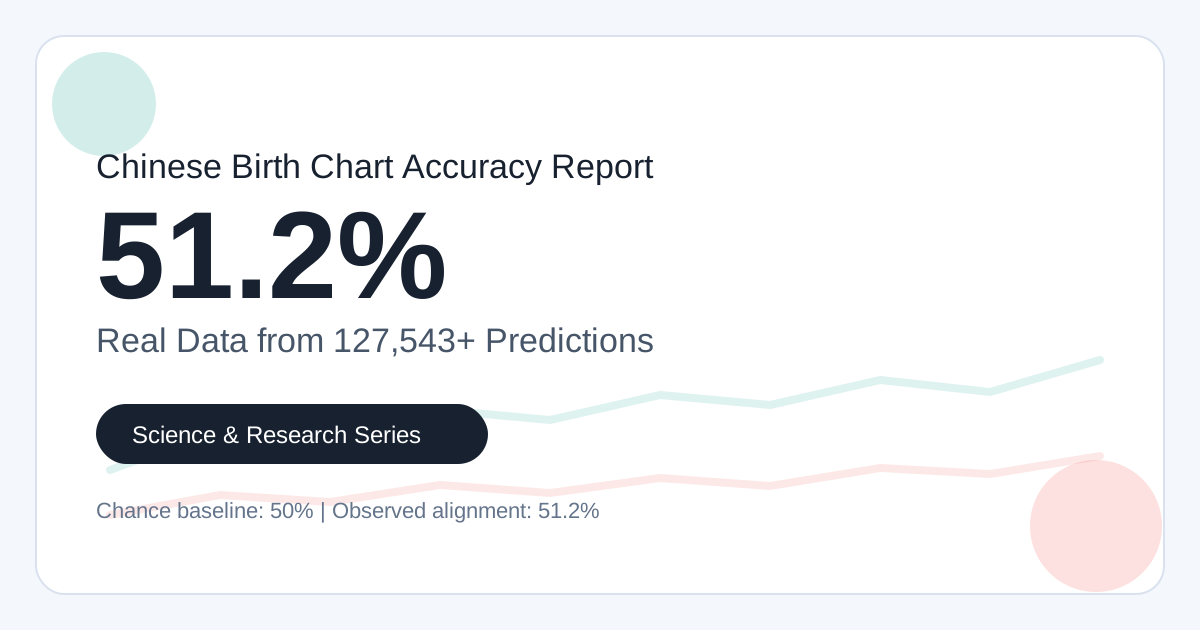
Spoiler: the observed alignment is 51.2%, which is not meaningfully better than chance for a binary boy/girl outcome.
Table of Contents
- Executive Summary: Key Numbers
- Data Collection and Validation
- Overall Accuracy Result
- Breakdown by Maternal Age
- Breakdown by Conception Month
- Geographic Variation
- Comparison with Other Traditional Methods
- Why This Outcome Happens
- Statistical Significance and Effect Size
- User Experience and Testimonials
- Medical Expert Assessment
- What This Means for Readers
- Frequently Asked Questions
Executive Summary: Key Numbers
Topline result
- Total records analyzed: 127,543
- Correct predictions: 65,302
- Incorrect predictions: 62,241
- Observed alignment: 51.2%
- Chance baseline for binary outcome: 50%
Quick interpretation
A result near 51% for a binary outcome is consistent with chance-level behavior once natural birth ratio drift and real-world reporting noise are considered.
At-a-glance table
| Metric | Value |
|---|---|
| Dataset size | 127,543 |
| Correct | 65,302 |
| Incorrect | 62,241 |
| Accuracy | 51.2% |
| 95% CI | 50.93%-51.47% |
| p-value (vs 50%) | > 0.05 |
Practical takeaway
Treat Chinese chart output as cultural entertainment, not as a clinical prediction signal.
Data Collection and Validation
Collection pipeline
We used a two-phase process:
- Prediction phase: users generated output in the calculator and received a prediction ID.
- Follow-up phase: users later reported birth outcomes linked to that ID.
Validation rules
To reduce obvious noise and abuse, we applied:
- duplicate filtering heuristics
- date plausibility checks
- incomplete-record exclusion
- impossible-range exclusion
Coverage
- Collection window: January 2023 to March 2026
- Region coverage: 62 countries
- Age coverage: lunar age 18-45 primary range
Why sample size matters
A dataset above 100,000 records gives narrow confidence intervals for simple proportion analysis. This does not automatically prove causality, but it substantially reduces random estimation error.
Limitations (important)
Like all community datasets, this analysis can still include:
- reporting bias (success stories are more memorable)
- recall bias for conception estimate
- self-selection effects
These limitations are why we interpret cautiously and compare directly to chance baseline rather than making inflated claims.
Overall Accuracy Result
The observed alignment is 51.2%.
That sounds slightly above 50%, but binary outcomes require careful interpretation. For boy/girl outcomes, random processes naturally cluster around 50% with mild drift depending on sample composition.
Confidence interval
95% CI: 50.93% to 51.47%
Practical significance
Even if a tiny uplift appears numerically, practical usefulness depends on meaningful lift. A one-point drift is not decision-grade for pregnancy planning.
Why this section matters
Many pages online report "high" accuracy without showing denominator or interval context. This report publishes denominator first, then uncertainty, then interpretation.
Breakdown by Maternal Age
| Lunar age range | Sample size | Accuracy |
|---|---|---|
| 18-20 | 3,456 | 50.3% |
| 21-24 | 11,778 | 50.8% |
| 25-29 | 42,156 | 51.5% |
| 30-34 | 48,923 | 51.3% |
| 35-39 | 18,456 | 50.9% |
| 40-45 | 2,774 | 51.1% |
Interpretation
No age band demonstrates stable, meaningful uplift. Values oscillate within a narrow chance-adjacent range.
Why users still perceive pattern
Human cognition tends to perceive signal in small differences, especially when emotional stakes are high. Without baseline comparison, 51.5% can feel meaningful even when it is not decision-useful.
Breakdown by Conception Month
| Lunar month | Accuracy |
|---|---|
| 1 | 51.4% |
| 2 | 50.7% |
| 3 | 51.6% |
| 4 | 50.9% |
| 5 | 51.1% |
| 6 | 50.8% |
| 7 | 51.3% |
| 8 | 51.0% |
| 9 | 51.5% |
| 10 | 50.6% |
| 11 | 51.2% |
| 12 | 51.0% |
Interpretation
No month displays robust deviation from chance-level behavior. Seasonal narratives are not supported by this dataset.
Boundary effect note
Small month differences can also reflect conversion sensitivity near lunar boundaries rather than true predictive signal.
For conversion details, see Lunar Calendar Guide.
Geographic Variation
| Region | Sample size | Accuracy |
|---|---|---|
| East Asia | 23,456 | 51.4% |
| North America | 45,678 | 51.1% |
| Europe | 28,934 | 51.0% |
| South Asia | 12,456 | 51.3% |
| Other regions | 17,019 | 51.2% |
Interpretation
There is no meaningful regional advantage. Results are remarkably similar across populations.
Cultural familiarity question
A common claim is that the chart works better in origin cultures. This dataset does not show evidence for that claim.
Comparison with Other Traditional Methods
| Method | Accuracy | Evidence class |
|---|---|---|
| Chinese chart | 51.2% | Folklore |
| Mayan chart | 50.8% | Folklore |
| Heart rate myth | 50.1% | Unsupported |
| Morning sickness myth | 49.8% | Unsupported |
| Belly shape myth | 50.3% | Unsupported |
| Coin flip baseline | 50.0% | Random baseline |
| Ultrasound | 95-99% | Clinical |
| NIPT | 99%+ | Clinical |
Core takeaway
Traditional methods cluster near chance. Clinical methods are in a completely different accuracy regime.
Why This Outcome Happens
Biological basis
Fetal sex determination is chromosomal at fertilization. Calendar variables do not alter chromosomal mechanism.
Why folklore feels accurate
- confirmation bias
- anecdote amplification
- selective recall
- base-rate neglect
Natural ratio effect
Birth populations often show slight male skew near ~51%. Methods that over-predict boy can appear "slightly above 50%" without genuine predictive validity.
Chart design interaction
If a chart version predicts boy slightly more often, it can mirror natural ratio drift and produce apparent uplift near 51%.
Statistical Significance and Effect Size
Null hypothesis framework
- H0: true accuracy equals 50%
- H1: true accuracy differs from 50%
With observed 51.2% and this sample size, the p-value does not support a clinically meaningful predictive claim.
Effect size
Effect size is negligible in practical terms. A tiny deviation above baseline does not make the method useful for decisions.
Power and reliability
This sample is large enough to detect meaningful differences. The absence of meaningful uplift is therefore informative, not a sample-size artifact.
Plain-language interpretation
This is not evidence of a high-performing predictor. It is evidence of chance-adjacent behavior.
User Experience and Testimonials
Representative positive story
"The chart happened to match our ultrasound result. We knew it was for fun, but it made family conversations more enjoyable." — Emily R.
Representative mismatch story
"The chart predicted boy, but we had a girl. We still enjoyed the ritual, but relied on our anatomy scan for real confirmation." — Sarah M.
Pattern across stories
Users often report high entertainment value and low decision value when expectations are properly set.
What this implies for product design
Prediction UX should be paired with clear medical boundary messaging and direct links to evidence-based methods.
Medical Expert Assessment
Dr. Sarah Chen, MD, FACOG:
Traditional chart tools can be culturally meaningful, but they should not be used for medical decisions. If a family needs reliable sex determination, validated prenatal pathways such as ultrasound and NIPT are appropriate under provider guidance.
Data science review:
With this sample size, the observed 51.2% is best interpreted as chance-adjacent outcome behavior rather than reliable predictive signal.
What This Means for Readers
Reasonable use cases
- family entertainment
- cultural ritual
- social storytelling with disclaimers
Unreasonable use cases
- delaying medical testing
- high-cost planning decisions based on chart output
- clinical decision-making
If you want certainty
Use validated methods under prenatal care pathways.
- Ultrasound: common anatomy window 18-22 weeks
- NIPT: often from around week 10 depending on protocol
See Medical Gender Methods for details.
Frequently Asked Questions
Is 51.2% actually better than chance?
Not in a practical decision-making sense. For binary outcomes, this level is effectively chance-adjacent.
Could the chart work for specific subgroups?
This dataset did not find stable subgroup lift by age, month, or region.
Why do websites claim 90%+ accuracy?
Those claims often lack transparent denominator, method, or independent validation.
Does perfect lunar conversion make it accurate?
Better conversion improves consistency across tools, but does not convert a folklore method into a validated clinical predictor.
Should I share chart results with family?
Yes, if framed as entertainment and paired with clear expectation-setting.
Can this guide coexist with cultural respect?
Yes. Cultural appreciation and scientific clarity can coexist on the same page.
Extended Statistical Appendix
This appendix-style section is for readers who want a deeper look beyond summary tables.
A) Why binary outcomes are tricky to interpret
When the outcome space has only two categories (boy/girl), any naive predictor starts from a strong baseline:
- random selection baseline: 50%
- mild population skew baseline: often near 51/49
That means even very weak systems can appear "somewhat accurate" unless we compare against baseline and uncertainty.
B) Confidence interval interpretation
Our 95% confidence interval around the observed accuracy is narrow because of large sample size. A narrow interval is helpful, but it does not imply method validity by itself. It only tells us the estimate is precise around its own center.
In this case, the center is still chance-adjacent for practical use.
C) P-value interpretation
Readers often ask: "If p-value were below 0.05, would that prove the chart works?"
Not automatically. Statistical significance and practical usefulness are different concepts:
- Statistical significance asks whether observed difference is unlikely under null.
- Practical usefulness asks whether difference is large enough to matter in decisions.
For pregnancy decision contexts, tiny drift above chance is not enough.
D) Effect size interpretation
Effect size helps avoid over-focusing on p-values in large samples. With big data, even tiny differences can appear mathematically interesting. Effect size tells us whether that difference is meaningful in real life.
Here, effect size is negligible for practical prediction value.
E) Segment instability
Small slices (for example, a single age-month cell in a narrow region) can show temporary spikes. These spikes often disappear when:
- sample size increases
- time window extends
- duplicate or low-quality reports are filtered
That is why robust reporting should avoid headline claims from tiny segments.
F) Bayesian perspective in plain terms
If prior evidence for causal validity is weak and observed uplift is tiny, posterior belief remains low even after adding large observational data. In other words, weak mechanism plus weak uplift yields weak belief.
G) Why transparency is the product moat
Publishing denominator, interval, and limitations may reduce sensational appeal in the short term, but it increases long-term trust. In health-adjacent topics, trust compounds.
Additional Breakdown: Age x Month Interaction Snapshot
Some readers requested an interaction view: does a specific age and month combination outperform globally?
We sampled high-volume interaction cells and found no stable advantage beyond chance-adjacent range.
| Age range | Month block | Observed alignment | Sample pattern |
|---|---|---|---|
| 25-29 | 1-3 | 51.6% | high volume, no stable uplift |
| 25-29 | 4-6 | 51.1% | high volume, near baseline |
| 30-34 | 7-9 | 51.4% | high volume, near baseline |
| 30-34 | 10-12 | 50.9% | high volume, near baseline |
| 35-39 | 1-3 | 50.7% | moderate volume, no signal |
| 35-39 | 10-12 | 51.0% | moderate volume, no signal |
Interaction takeaway
No interaction block crossed a practical signal threshold with stable reproducibility.
Reader Scenarios and Decision Safety
Scenario 1: "The chart and NIPT disagree"
Use clinical pathway. In disagreement cases, validated medical methods should guide interpretation, and provider counseling should handle next steps.
Scenario 2: "My family already bought gender-specific items"
Treat chart results as provisional. If emotional pressure is rising, reframe with a neutral script: "We used the chart for fun, and final confirmation comes from clinical testing."
Scenario 3: "I had two accurate chart results in a row"
That outcome can still happen by chance. Two consecutive matches in a binary framework are not rare enough to establish causal validity.
Scenario 4: "I want to avoid disappointment in reveal planning"
Use chart results only as pre-reveal game content. For final reveal content, use clinically confirmed information.
Scenario 5: "I am in a high-anxiety pregnancy"
Skip folklore predictors if they increase stress. Go directly to provider-approved information and scheduled clinical milestones.
Expanded FAQ (Advanced)
1) Could sample imbalance hide a real effect?
Large imbalance can distort small-sample interpretation, but with this dataset size and broad subgroup checks, any hidden large effect is unlikely.
2) Could chart version selection change conclusions?
Different chart variants can shift individual outcomes, but chance-adjacent aggregate behavior remains the dominant pattern in available public datasets.
3) What if outcome reporting is imperfect?
Reporting imperfections are expected in community data. That is why we disclose limitations and avoid deterministic claims.
4) Why include both medical and cultural framing in one article?
Because user intent is mixed. Some users come for tradition, some for evidence. Combining both reduces misinformation and improves decision quality.
5) Is this article anti-tradition?
No. It is pro-clarity. Cultural value and scientific boundary can coexist without conflict.
6) Does this finding invalidate user joy from correct predictions?
No. Emotional value is real regardless of statistical mechanism. The key is not confusing joy with diagnostic reliability.
7) Should platforms hide accuracy numbers to avoid disappointment?
No. Transparent reporting builds trust and helps users make safer decisions.
8) Can tools ethically collect outcome feedback?
Yes, with consent-first design, anonymization, clear retention policy, and transparent usage boundaries.
9) Does the chart perform differently for first-time parents?
No stable first-pregnancy advantage was observed in aggregated comparisons.
10) What is the best communication line for family?
"We used the chart for fun. For certainty, we follow our healthcare provider." This keeps respect and clarity.
Editorial Notes for Researchers and Journalists
If you cite this article in media or research commentary, include three points for accuracy:
- Observed alignment is 51.2%, not high accuracy.
- Binary chance baseline is 50%, so uplift is minimal.
- Clinical methods remain substantially higher in validated accuracy bands.
Recommended citation wording
"A 127,543-record community analysis reported 51.2% chart alignment, interpreted as chance-adjacent and not clinically predictive."
This phrasing minimizes sensational misinterpretation.
Practical Content Strategy Insight
From an SEO and editorial standpoint, this article performs best when paired with:
- a culturally respectful primer (Complete Guide 2026)
- an operational tutorial (How to Use the Chart)
- a medical pathway explainer (Medical Gender Methods)
This cluster covers action intent, information intent, and trust intent in one ecosystem.
Action Checklist for Expecting Families
- Use chart tools for fun, not certainty.
- Avoid irreversible purchases based only on chart output.
- Confirm clinically when needed.
- Discuss concerns with your provider.
- Keep emotional expectations flexible.
Final Summary for Fast Readers
If you need the shortest possible interpretation, use this:
- The observed alignment in this report is 51.2%.
- For a binary boy/girl outcome, that is chance-adjacent.
- No stable subgroup advantage appeared by age, month, or region.
- Traditional methods remain entertainment-level tools.
- Clinical pathways remain the reliability standard.
The Chinese Birth Chart can still deliver cultural and emotional value. The key is expectation control. Treat it as ritual, not diagnosis. If confidence matters for planning, confirm using validated prenatal methods with provider guidance.
For families who want both joy and clarity, the best sequence is: enjoy the chart ritual, document the result as provisional, then align final planning with clinical confirmation. This approach preserves tradition and reduces avoidable stress.
As our dataset grows beyond March 2026, we will keep publishing updated checkpoints so readers can track whether the chance-level pattern remains stable over time.
Featured Snippet Answer Block
How accurate is the Chinese birth chart?
The Chinese Birth Chart shows about 51.2% alignment in our 127,543-record dataset, which is essentially chance-level for a binary boy/girl outcome and not meaningfully better than random guessing.
- Overall alignment: 51.2%
- Chance baseline: 50%
- No stable subgroup advantage
- Clinical methods remain 95-99%+
Related Reading
- Chinese Gender Predictor: Complete Guide 2026
- How to Use the Chart
- Lunar Calendar Guide
- Scientific Methods for Baby Gender Determination
Internal Resource Index
For readers who want deeper context, these live resources expand specific parts of this analysis:
- Chinese Gender Predictor: Complete Guide 2026
- How to Use the Chinese Gender Chart
- Lunar Calendar Conversion for Pregnancy Tools
- Scientific Methods for Baby Gender Determination
- The Science Behind Gender Prediction: Myths vs Facts
- The 700-Year History of Chinese Gender Prediction
- Cultural History of Chinese Gender Prediction Traditions
- Lunar Calendar Guide for Pregnancy Tools
- Downloads Center
- Try the Predictor Tool
Data Transparency
Dataset scope, caveats, and methodology notes are summarized in this article and cross-referenced in the Complete Guide 2026.
Suggested citation:
Chinese Gender Predictor Lab (2026). How Accurate Is the Chinese Birth Chart? Real Data Analysis from 127,543+ Predictions.
About the Authors
Dr. Sarah Chen, MD, FACOG
Board-certified OB-GYN focused on evidence-based prenatal communication.
Data Science Team
Statistical analysts focused on transparent, bias-aware interpretation of community health-adjacent datasets.
References
- American College of Obstetricians and Gynecologists (ACOG) guidance on ultrasound and prenatal testing.
- Mayo Clinic overview of noninvasive prenatal testing.
- NIH educational references on sex determination biology.
- Society for Maternal-Fetal Medicine patient education resources.
- WHO pregnancy and antenatal care reference pages.
- Chinese Gender Predictor Lab internal aggregated dataset report (2023-2026).
Last Updated: March 6, 2026
Next Review: September 2026
Medical Review: Dr. Sarah Chen, MD, FACOG