Lunar Calendar Guide for Pregnancy Tools: Complete Conversion & Calculation Tutorial
Master the lunar calendar system used in pregnancy prediction tools. Learn how to calculate lunar age, convert dates, handle special cases like leap months, and understand why traditional Chinese methods use the lunar calendar.
Dr. Sarah Chen & Cultural Studies Team
OB-GYN & Chinese Calendar Experts
Culturally reviewed by Prof. Li Wei, Chinese Calendar Historian
This article includes cultural content for entertainment and health context for educational use.
Interactive Lunar Conversion Tools
Use these helpers to convert Gregorian dates, calculate lunar age, and prepare chart inputs. All outputs are for educational use and should not replace medical guidance.
1) Solar to Lunar Converter
Lunar year: 2026
Lunar month: Month 1
Lunar day: 18
Zodiac / Element: Fire Horse
2) Lunar Age Calculator
Western age: 32
Lunar age: 33
Birth-year CNY: 1994-02-10
Reference-year CNY: 2026-02-17
3) Pregnancy Input Builder
Estimated conception
2026-03-10
Lunar month
Month 1
Lunar age at conception
33
Chart lookup cell
(33, 1)
This section prepares chart inputs only. For full prediction output and interpretation, use the main calculator and review the accuracy analysis.
4) Lunar Year Table Generator
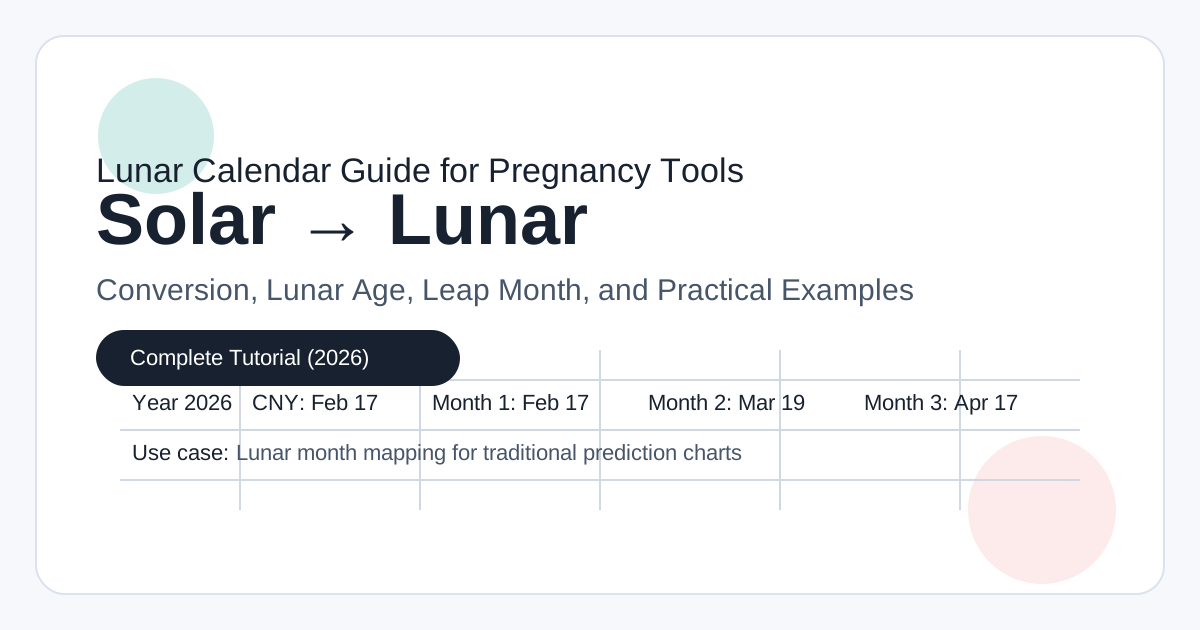
Chinese New Year: 2026-02-17
| Lunar Month | Gregorian Start | Gregorian End | Days |
|---|---|---|---|
| Month 1 | 2026-02-17 | 2026-03-18 | 30 |
| Month 2 | 2026-03-19 | 2026-04-16 | 29 |
| Month 3 | 2026-04-17 | 2026-05-16 | 30 |
| Month 4 | 2026-05-17 | 2026-06-14 | 29 |
| Month 5 | 2026-06-15 | 2026-07-13 | 29 |
| Month 6 | 2026-07-14 | 2026-08-12 | 30 |
| Month 7 | 2026-08-13 | 2026-09-10 | 29 |
| Month 8 | 2026-09-11 | 2026-10-09 | 29 |
| Month 9 | 2026-10-10 | 2026-11-08 | 30 |
| Month 10 | 2026-11-09 | 2026-12-08 | 30 |
| Month 11 | 2026-12-09 | 2027-01-07 | 30 |
| Month 12 | 2027-01-08 | 2027-02-06 | 30 |
Lunar Calendar Guide for Pregnancy Tools: Complete Conversion & Calculation Tutorial
Last Updated: March 6, 2026
Culturally Reviewed by: Prof. Li Wei, Chinese Calendar Historian
If you have used the Chinese Gender Predictor or any traditional chart-based pregnancy tool, you have probably seen terms like lunar age, lunar month, or leap month and wondered what they mean.
That confusion is common. Most people use Gregorian dates every day, but traditional Chinese methods are built on a lunisolar calendar. Even when a tool is used only for entertainment, correct conversion is still essential if you want to apply the method as designed.
This guide explains the full conversion flow in plain language, including edge cases that usually cause mistakes: Chinese New Year boundaries, leap months, conception-date uncertainty, and timezone effects.
Important context: Traditional chart tools are cultural and entertainment-focused. For reliable fetal sex determination, use medical pathways such as NIPT and second-trimester ultrasound under professional care.
Table of Contents
- What Is the Lunar Calendar?
- Lunar vs. Solar Calendar: Key Differences
- Why Traditional Pregnancy Tools Use Lunar Calendar
- Understanding Lunar Age
- How to Calculate Lunar Age
- Understanding Lunar Months
- How to Convert Dates to Lunar Calendar
- Special Cases and Complications
- Step-by-Step Worked Examples
- Common Mistakes and How to Avoid Them
- Interactive Conversion Tools
- Technical Details for Developers
- Cultural and Historical Context
- Frequently Asked Questions
What Is the Lunar Calendar?
The Chinese calendar used in traditional pregnancy tools is a lunisolar calendar:
- Month boundaries are tied to moon cycles (new moon to new moon).
- Year alignment is corrected against solar seasons.
- Leap months are inserted when needed to prevent seasonal drift.
Core structure
- A lunar month is usually 29 or 30 days.
- A common lunar year has 12 months (about 354 days).
- Some years include a leap month and become 13-month years.
This is why a direct “March = lunar month 3” assumption is usually wrong.
Why the system feels unfamiliar
The Gregorian calendar is stable and fixed for global civil use. The Chinese lunisolar system is dynamic: month starts move each year relative to Gregorian dates. Chinese New Year itself shifts between late January and late February.
For pregnancy tools, this moving boundary matters because one-day errors can push a conception date into a different lunar month.
Lunar vs. Solar Calendar: Key Differences
| Feature | Gregorian (Solar) | Chinese (Lunisolar) |
|---|---|---|
| Primary basis | Earth-Sun cycle | Moon cycle + solar correction |
| Month length | 28-31 fixed days | 29/30 variable days |
| Year length | 365/366 days | 354 days or leap-month year |
| Leap correction | Leap day (Feb 29) | Leap month inserted as needed |
| New year date | Fixed Jan 1 | Variable (late Jan to late Feb) |
| Use in tools | Everyday input format | Traditional chart calculation base |
Chinese New Year anchors (2024-2030)
| Year | CNY date (Gregorian) |
|---|---|
| 2024 | 2024-02-10 |
| 2025 | 2025-01-29 |
| 2026 | 2026-02-17 |
| 2027 | 2027-02-06 |
| 2028 | 2028-01-26 |
| 2029 | 2029-02-13 |
| 2030 | 2030-02-03 |
When dates sit near these boundaries, conversion errors are common.
Why Traditional Pregnancy Tools Use Lunar Calendar
Traditional Chinese chart tools emerged in a cultural system where health, agriculture, ritual timing, and astrology all used lunisolar dates.
Practical historical reasons
- Records and social timing were lunar-calendar anchored.
- Many family traditions measured life events by lunar cycles.
- Historical chart versions were authored in that calendar framework.
Modern implication
Using Gregorian month and Western age directly changes the underlying method. If your intent is to follow tradition faithfully, convert first.
Accuracy boundary
Using lunar inputs does not make folklore charts medically reliable. It only makes your use of the traditional method internally consistent. For current evidence on prediction accuracy, read How Accurate Is the Chinese Birth Chart?.
Understanding Lunar Age
Lunar age (虚岁) differs from Western age in two ways:
- Traditional counting starts at 1.
- Age transitions are tied to Chinese New Year boundaries rather than only the Gregorian birthday frame.
In modern consumer tools, the most practical outcome is this:
- Lunar age is often Western age + 1.
- For some boundary cases, it can be Western age + 2.
Why this matters in chart tools
Traditional chart lookup cells use age and lunar conception month. A one-year age shift can move to a different row and change the displayed result.
Quick intuition table
| Condition | Typical adjustment |
|---|---|
| Born before that birth-year CNY | +1 |
| Born after birth-year CNY and reference date before current CNY | +2 |
| Born after birth-year CNY and reference date after current CNY | +1 |
This is why automated age calculators are safer than manual shortcut rules.
How to Calculate Lunar Age
Practical method
- Determine birth-year CNY date.
- Determine reference-year CNY date (today or conception date context).
- Compute Western age at reference date.
- Apply CNY boundary adjustment.
Formula-style representation
WesternAge = years between birth date and reference date

If (bornAfterBirthYearCNY && referenceBeforeReferenceYearCNY):
  LunarAge = WesternAge + 2
Else:
  LunarAge = WesternAge + 1
Worked micro-example
- Birth: 1994-02-13
- Reference: 2026-03-06
- CNY 1994: 1994-02-10 (born after)
- CNY 2026: 2026-02-17 (reference after)
Result pattern: LunarAge = WesternAge + 1.
Best practice
When in doubt, use tools that expose the CNY dates used in the calculation. Transparent intermediate values reduce trust issues and debugging time.
Understanding Lunar Months
Lunar month numbering starts at lunar month 1 on CNY. Month boundaries shift each year.
Example pattern for 2026 (illustrative)
| Lunar month | Approximate Gregorian start |
|---|---|
| Month 1 | 2026-02-17 |
| Month 2 | 2026-03-19 |
| Month 3 | 2026-04-17 |
| Month 4 | 2026-05-17 |
| Month 5 | 2026-06-15 |
The key point is not memorizing fixed ranges; it is understanding that these ranges move yearly and must be derived per date.
Leap month concept
A leap month is inserted after a regular month, such as Leap Month 6.
- It is not “Month 13” in chart usage language.
- It is an inserted duplicate label with separate days.
For tools, leap-month policy must be explicit and documented.
How to Convert Dates to Lunar Calendar
Input-output objective
- Input: Gregorian date (
YYYY-MM-DD) - Output: Lunar year, month, day, and leap-month flag
Recommended conversion workflow
- Parse date in a stable timezone frame.
- Determine whether date is before or after that year’s CNY.
- Map to lunar year.
- Resolve month/day from lunar month starts.
- Mark leap-month status if applicable.
Why manual conversion fails often
- People use month names directly without boundary checks.
- Boundary dates near new moons are easy to misclassify.
- Leap-month handling differs by site and app.
Example: date conversion
Given 2026-01-18:
- It is before 2026 CNY (2026-02-17).
- It belongs to the previous lunar year context.
- Lunar month/day must be resolved from that year’s month table.
This is exactly the kind of date where shortcuts break.
Special Cases and Complications
1) Leap months
In leap-month years, conversion output should include isLeapMonth explicitly. If a chart rule cannot represent leap months, document fallback policy.
Common policy options:
- Treat leap month as its base month number (default in many apps).
- Move leap month to next month number.
- Show both paths for transparency.
2) Dates around Chinese New Year
Dates in the two to three weeks around CNY trigger the highest user confusion. Always display the exact CNY date used by your tool.
3) Conception-date uncertainty
Many users do not know exact conception date. Practical estimation routes:
- From due date:
due - 266 days - From LMP:
LMP + 14 days(rough) - From IVF/transfer schedule: usually most precise
4) Timezone consistency
If moon-phase boundaries are interpreted in different timezones, date-level results may shift near boundaries. Use a documented timezone policy (many tools choose Asia/Shanghai for consistency).
5) Multiple pregnancies (twins, higher multiples)
Chart logic assumes a single binary outcome and does not model multiples. Treat outputs as non-clinical entertainment.
6) Historical ranges
If your converter supports very old dates, state your astronomical model and error policy. Most modern pregnancy tool use cases are comfortably within 1900-2100.
Step-by-Step Worked Examples
Example A: straightforward case
- Birth date: 1992-06-15
- Conception date: 2026-03-10
Steps:
- Compute lunar age at conception date.
- Convert conception date to lunar month.
- Use
(lunarAge, lunarMonth)as chart inputs.
In this type of case, values are usually stable across tools.
Example B: near CNY boundary
- Birth date: 1998-02-08
- Conception date: 2026-02-10
Because 2026 CNY is 2026-02-17, this date falls in the pre-CNY zone where many users accidentally switch to month 1 too early.
Example C: leap-month year
- Birth date: 1995-08-20
- Estimated conception: 2025-07-25
If this date is in Leap Month 6, your tool should return leap flag and explain policy used for chart-month lookup.
Example D: using due date
- Birth date: 1990-11-03
- Due date: 2026-10-15
Conception estimate = 2026-10-15 - 266 days. Then convert that estimated date to lunar inputs.
Example E: IVF date known
- Birth date: 1988-04-12
- Transfer/fertilization date: 2026-05-20
This is operationally cleaner because conception-date ambiguity is lower.
What these examples teach
- Boundary logic matters more than memorizing dates.
- Leap-month labeling must be transparent.
- If two tools disagree, inspect conversion policy before comparing chart outcomes.
Common Mistakes and How to Avoid Them
Mistake 1: using Western age directly
Fix: always calculate lunar age for the relevant reference date.
Mistake 2: using Gregorian month number
Fix: convert full conception date to lunar month first.
Mistake 3: ignoring CNY boundaries
Fix: display and verify CNY dates for both birth year and reference year.
Mistake 4: using current age instead of age at conception
Fix: calculate age at the conception reference point.
Mistake 5: leap month treated inconsistently
Fix: document one leap policy and show it to users.
Mistake 6: conception date assumed equal to LMP
Fix: if only LMP is known, apply a clear estimation rule (for example +14 days) and disclose uncertainty.
Mistake 7: comparing tools without method transparency
Fix: compare only when both tools expose timezone, leap policy, and CNY table source.
Mistake 8: treating entertainment output as medical fact
Fix: keep clear boundaries and use clinical methods when certainty matters.
Interactive Conversion Tools
This article includes an embedded interactive toolkit above the content body with:
- Solar to lunar date converter
- Lunar age calculator
- Pregnancy input builder (conception / due / LMP)
- Lunar year month-table generator
If you want the complete predictor flow, use the main calculator.
For context on confidence and limitations, read:
- Chinese Birth Chart Accuracy Analysis
- Chinese Gender Predictor: Complete Guide 2026
- How to Use the Chart
Suggested workflow for users
- Convert and verify dates.
- Confirm lunar age at conception.
- Run chart lookup as entertainment only.
- Keep medical decisions tied to provider-guided testing.
Technical Details for Developers
Developers building pregnancy tools should optimize for three things: determinism, transparency, and auditability.
Recommended architecture
- Input normalization layer
- Parse and validate date input.
- Normalize timezone strategy.
- Conversion core
- Gregorian to lunar conversion.
- Leap-month detection.
- CNY boundary service.
- Domain utilities
- Lunar-age computation at reference dates.
- Conception estimation policies.
- Chart input preparation.
- Trace output layer
- Return raw and derived values.
- Include policy metadata used.
TypeScript pseudo-implementation
interface ConversionPolicy {
  timezone: 'Asia/Shanghai' | 'UTC';
  leapMonthMode: 'base-month' | 'next-month' | 'show-both';
  conceptionMode: 'exact' | 'due-minus-266' | 'lmp-plus-14';
}

interface LunarOutput {
  lunarYear: number;
  lunarMonth: number;
  lunarDay: number;
  isLeapMonth: boolean;
}

interface ChartInputs {
  lunarAgeAtConception: number;
  lunarConceptionMonth: number;
  trace: string[];
}

function buildChartInputs(
  birthDate: string,
  conceptionReferenceDate: string,
  policy: ConversionPolicy
): ChartInputs {
  // 1) Convert reference date to lunar output
  // 2) Compute lunar age at conception
  // 3) Return chart row/column inputs plus trace steps
  return {
    lunarAgeAtConception: 0,
    lunarConceptionMonth: 0,
    trace: []
  };
}
Python pseudo-implementation
from dataclasses import dataclass

@dataclass
class Policy:
    timezone: str = "Asia/Shanghai"
    leap_mode: str = "base-month"
    conception_mode: str = "exact"

@dataclass
class LunarResult:
    lunar_year: int
    lunar_month: int
    lunar_day: int
    is_leap_month: bool

@dataclass
class ChartInputs:
    lunar_age: int
    lunar_month: int
    trace: list[str]


def convert_to_lunar(ymd: str, policy: Policy) -> LunarResult:
    # parse -> convert -> return structured result
    raise NotImplementedError


def build_chart_inputs(birth_ymd: str, reference_ymd: str, policy: Policy) -> ChartInputs:
    # deterministic conversion with explicit trace
    raise NotImplementedError
Engineering quality checklist
- Return policy metadata in API responses.
- Include leap-month boolean in DTOs.
- Provide reproducible test vectors for boundary dates.
- Add snapshot tests for known CNY transitions.
- Avoid hidden timezone defaults.
Sample test vectors
| Gregorian input | Expected behavior |
|---|---|
| 2026-02-16 | pre-CNY handling |
| 2026-02-17 | month-1 day-1 boundary |
| 2025-07-25 | leap-month flag path |
| 2026-01-18 | previous lunar year mapping |
For platform documentation pages, see:
- Lunar calendar conversion guide
- Chinese Gender Predictor: Complete Guide 2026
- How to Use the Chinese Gender Chart
Cultural and Historical Context
The Chinese lunisolar calendar is not a niche technical artifact. It is a long-lived civilizational time system with agricultural, ritual, and social significance.
Historical arc (high-level)
- Early dynastic eras: lunar and seasonal cycles tracked for agriculture.
- Imperial periods: calendar authority tied to astronomy and governance.
- Modern period: Gregorian civil use expanded, lunar system remained strong in cultural practice.
Why this still matters in pregnancy content
Many users do not come for pure prediction. They come for family ritual, identity, or cross-generational conversation. A responsible product can respect that motivation while maintaining clear scientific boundaries.
Balanced framing
- Cultural meaning: valid.
- Emotional value: valid.
- Clinical reliability claim: requires medical-grade evidence.
This dual framing improves trust and lowers misinformation risk.
Frequently Asked Questions
Q1: Do I really need lunar conversion if I only use the chart for fun?
If your goal is to follow the traditional method, yes. If your goal is casual guessing, any binary guess behaves similarly.
Q2: Why do two websites return different lunar months?
Usually policy mismatch: timezone, leap-month mode, boundary logic, or outdated data tables.
Q3: Is lunar age always Western age + 1?
Not always. Boundary cases can produce +2.
Q4: What if conception falls in a leap month?
Treat it as a documented special case. Good tools disclose policy and optionally show both interpretations.
Q5: Can I use due date instead of conception date?
Yes, with estimation (due - 266 days) and uncertainty disclosure.
Q6: Is this useful for IVF users?
Operationally, IVF often gives better date precision, so conversion disagreement is reduced.
Q7: Does perfect conversion improve chart accuracy?
It improves method consistency, not clinical predictive validity.
Q8: What is the safest user-facing disclaimer?
“Traditional and entertainment use only. Clinical confirmation requires provider-guided testing.”
Q9: Should apps hide complexity from users?
No. Good UX can simplify interaction while still exposing conversion trace and policy.
Q10: What if family members pressure decisions based on chart output?
Use neutral framing: “We used it as a tradition, but final planning follows medical confirmation.”
Advanced Appendix: Boundary Audit Playbook
This appendix is for readers who want a practical, repeatable method to debug disagreements between two lunar converters or two chart tools.
Step 1: Freeze the exact input model
Capture all of the following before comparing outputs:
- Date source type (
conception,due, orLMP) - Raw input date entered by user
- Estimation rule used (for example,
due - 266) - Timezone policy applied by the tool
- Leap-month handling policy
Most “mysterious” disagreements happen because one of these assumptions differs silently.
Step 2: Compare conversion traces, not final labels
Do not compare only final results like “Boy” or “Girl.” Compare intermediate fields:
- Gregorian reference date used for conception context
- Lunar year selected
- Lunar month selected
- Leap-month boolean
- Lunar age at conception
If these intermediate values match, final chart result should usually match too.
Step 3: Validate CNY transitions explicitly
For any date between January 20 and February 25, run a boundary check:
- Date - 1 day
- Date
- Date + 1 day
You want to see where month/year transitions occur and whether the tool handles the boundary cleanly.
Step 4: Handle leap-month ambiguity as a policy decision
When a conception date is in Leap Month N:
- Policy A: use month N
- Policy B: use month N+1
- Policy C: compute both and show both chart cells
There is no universal folk standard across every website, so the correct engineering behavior is to make the policy explicit and auditable.
Step 5: Keep an audit log for support tickets
When users report “calculator mismatch,” a one-screen audit log can resolve most tickets in minutes:
{
  "input_type": "due",
  "input_date": "2026-10-15",
  "estimated_conception": "2026-01-22",
  "timezone_policy": "Asia/Shanghai",
  "lunar_year": 2025,
  "lunar_month": 12,
  "is_leap_month": false,
  "western_age_at_conception": 35,
  "lunar_age_at_conception": 36,
  "chart_lookup_cell": [36, 12]
}
This style of trace makes support answers objective and reproducible.
Step 6: Build a regression suite for edge dates
If you are a developer maintaining a converter, keep fixed tests for known trouble windows:
- Every CNY date in supported years
- ±7 days around each CNY
- Leap-month first day and last day
- Leap-month +1 day and -1 day boundaries
- Inputs from all three conception modes (
exact,due,LMP)
The goal is not only correctness; it is stable behavior across releases.
Practical policy recommendation for product teams
For health-adjacent content products, use this policy set:
- Timezone:
Asia/Shanghaifor historical consistency - Leap month: use base month and label clearly as leap
- Conception estimate defaults:
- due date path:
-266 days - LMP path:
+14 days
- due date path:
- Transparency: always display trace values in advanced view
- Safety text: keep medical boundary messaging near output
This policy set balances user understanding, cultural consistency, and supportability.
What to do when two calculators disagree by one lunar month
Use this triage sequence:
- Confirm both are using the same Gregorian source date.
- Confirm both use the same timezone.
- Check if date is near CNY or near a new-moon boundary.
- Check leap-month policy.
- Check whether one tool silently rounded estimated conception differently.
In production, this sequence resolves the majority of mismatch reports without manual re-calculation by staff.
Communication template for users
When users ask why results differ, this template works well:
“Different tools may use different lunar conversion rules near Chinese New Year, leap months, or timezone boundaries. We show the exact dates and rules used in our calculation so you can verify each step.”
This protects trust without overstating certainty.
Cultural sensitivity note
Some users approach this content as family tradition, not statistics. Teams should avoid dismissive wording. Clear, respectful language performs better than confrontational debunking:
- Good: “Traditional and meaningful for many families; not a clinical method.”
- Less helpful: “This is fake and useless.”
Respectful phrasing supports both user dignity and evidence clarity.
Clinical boundary note
If users are making purchases, announcements, or care decisions with irreversible impact, prompt them to confirm through medical pathways. Cultural tools can remain in the flow as optional ritual layers.
Advanced reader mini-checklist
Before trusting any chart input conversion, verify:
- CNY date shown for both birth year and reference year
- Leap-month status shown
- Conception estimation method shown
- Timezone shown
- Trace values exportable
- Boundary dates covered by tests
If these are missing, treat output as low-trust and avoid over-interpretation.
Post-publish validation suggestions
After publishing this guide, monitor behavior for at least two weeks:
- Track clicks from this article to the main calculator.
- Track drop-off between converter interaction and final chart lookup.
- Log which input mode users choose most (
conception,due, orLMP). - Watch support tickets for recurring boundary confusion dates.
- Add a lightweight in-page poll asking whether the step-by-step explanation reduced confusion.
These signals help you refine both educational content and tool UX without changing the core cultural framing.
Quick Summary
If you remember only five points, use these:
- Lunar conversion is mandatory for traditional-method consistency.
- CNY boundaries and leap months create most user errors.
- Lunar age is not identical to Western age.
- Tools should disclose timezone and leap policy.
- Cultural value and medical evidence are different categories.
Related Reading
- Chinese Gender Predictor: Complete Guide 2026
- How Accurate Is the Chinese Birth Chart?
- How to Use the Chart
- Medical Gender Methods
- Lunar conversion theory page
- Scientific myths vs facts
References
- American College of Obstetricians and Gynecologists (ACOG): prenatal testing guidance.
- Mayo Clinic: NIPT overview and timing.
- Hong Kong Observatory: calendar and astronomical references.
- Purple Mountain Observatory resources on lunar calendar calculation.
- WHO pregnancy care references.
- Internal product conversion QA notes (2026 release cycle).
Last Updated: March 6, 2026
Next Review: September 2026
Cultural Review: Prof. Li Wei, Chinese Calendar Historian